Astrology
Astrology is the study of the planets’ influence over the course of a person or event’s lifetime. Our chart is our individual cosmic fingerprint, a polaroid photograph of what the sky looked like at the moment we took our first breath. It’s a snapshot of the planetary gods mid-discussion, and that discussion works its way out physically in our earthly experiences over the course of our lives on earth. Below is a history of how the art and science of interpreting the heavens developed.
Mesopotamian Roots
The practice of divination seemed to already have be in operation in ancient Mesopotamia, modern-day Iraq, around 2,100 BCE. We have evidence of King Gudea, a great builder whom scholars believe to be one of the last Sumerian kings to rule Mesopotamia needing divine guidance to build temples, and he would seek it out with different methods like sacrificing goats to read their entrails, pouring oil into water to look at the pattern it made, or interpreting his dreams. 1 Then they would cross-reference the different messages from the gods, looking for commonalities and agreements between them so the king knew how to act.
This is when the ancient people who lived between the Tigris and Euphrates rivers would observe the planets moving through the sky at night. In ancient times, people had a different relationship to the sky than we do today with our urban light pollution and electronic distractions in the home in the evening. At night, there was little else to do for entertainment but look up at the sky and notice the positions of the planets and how they were interacting with each other in terms of their speed, their proximity or distance, and their visibility or invisibility. In the summer when it was hot, people would sleep outside on their roofs where they could get a bit of a breeze, away from the mosquitos, and fall asleep noting with dread how quickly Venus was moving toward the red war planet Mars, for example, or looking forward to the festivities when Sirius would make its heliacal rise over the horizon in July2.
Observing the stars wasn’t just for the layman- kings and military leaders consumed this information like today’s leaders might consume daily political briefs.
Mesopotamians noticed that the activities of the planets in the sky corresponded with military successes or losses, for example, the births and deaths of kings and their children, or the ups and downs of the prices of commodities. However, in the ancient mind, it wasn’t the planets causing the events on earth; rather, the planets and stars were simply communicating messages from the gods of their intentions, and it was the humans’ job to decipher those messages like a language. In fact, kings would have many scholars on staff who would keep vast records of data about world events, the weather, prices of goats and wheat, for example, along with what was happening in the sky each night. Scholars would press their observations into wet clay tablets with their language, cuneiform, and send them to the King (if they weren’t already, they were hoping that their insights would get them employed by him). Those tablets ended up filling large libraries that have survived to this day, thanks to the durable nature of clay and the way they were buried when Mesopotamian cities were abandoned.
Eclipses in particular were studied because of how dramatic they are, both visually (ie. the sun disappearing from view in the middle of the day), but also astrologically: they tend to bring out sudden and often surprising events. The Sun is the archetype for the king, the leader, the father, and royalty in general, so these events often affected the royal families. The blazing, life-giving sun which groggily made its way over the eastern horizon in the morning and rose to the top of the sky at noon-hour to reach its full strength; this journey was an archetype of a King’s journey to ascending to his throne robed in golden glory. But during a solar eclipse, for example, the moon literally moved in front of the sun, “eclipsing” the sun out of view from the sky while the land dwelt in momentary darkness– Jesus himself experienced a solar eclipse when he died– so a king would want to be prepared ahead of time with the appropriate remedies to keep his kingdom intact during eclipse season.
Let’s take a modern example. Consider how the British monarchy has been affected by eclipses in the 20th century alone, and we can start to appreciate why the ancient leaders kept such a close watch on the sky for any omens that may portend a sudden tragedy.
- King Charles was coronated on May 6, 2023, the day after a lunar eclipse. He was born 2 weeks after an eclipse on November 14, 1948
- Prince William was born on the day of a solar eclipse on June 21, 1982. Kate Middleton was also born on a lunar eclipse- January 9, 1982.
- Princess Diana died two days before a solar eclipse on August 31, 1997 (the solar eclipse was on Sept 2, 1997)
- A generation prior, King George VI died on February 6, 1952, five days after a lunar eclipse on February 11, 1952, when Queen Elizabeth took the throne.
- 16 years prior to that, King Edward VIII abdicated the throne to marry a divorcée, Wallis Simpson, on Dec 10, 1936, three days before a solar eclipse on December 13. This threw his unsuspecting brother, George VI, into the spotlight to take the throne.
- The brothers George and Edward’s father, King George V, died on January 20, 1936, 12 days after a lunar eclipse on January 8, 1936.
- George V’s father, Edward VII, died on May 6, 1910, three days before a solar eclipse, which led to George V’s ascension.3
And this is just a partial list of eclipse-related events affecting one particular royal family during the 20th century. Extrapolate this to other royal families over the rest of human history.
Mesopotamian culture lasted for over 2,000 years, and for a large part of that time, they were tracking the movement of the planets. One of their biggest successes was learning how to predict when planets would be in certain positions in the future and record them in ephemerides– catalogues of times and locations so they could make future predictions. As they developed more and more complex mathematics, they learned the planetary cycles and noticed certain patterns, like “If such and such happens, then this will happen”. They began to associate certain planetary occurrences with certain outcomes, and would inscribe these lists of omens on specific clay tablets in a syntax researchers call protasis-apodosis, or “p’s and q’s”. An example omen would be, “If someone is born when Canicula (Sirius) is rising, he will not die in the ocean.4” The king’s astrologers would pass on these omens to the next generation of apprentices (often their sons) and have them memorized. They re-wrote the omen tablets many times over for subsequent generations of scholars to carry on their observances and build on their knowledge.
One of the most important astrological and astronomical texts for Mesopotamians, MUL.APIN, was likely written about 1,000 BCE. It’s a relatively long reference text with eight important lists that an astrologer would want to know and reference in their correspondence with the king– a catalog of stars and constellations, a list of heliacal risings and other planetary cycles and historically-observed behavior.5
It is worth remembering how fused the study of Astrology and Astronomy were- there was zero distinction in the minds of Mesopotamian scholars between the two- the scientific observation of the night sky fed into meaning-making- it was the king’s guidance from the gods. But also, the study of the celestial bodies was how Mesopotamians organized time and seasons; they came up with complex mathematics to calculate the length of the year, as well as the length of planetary and solar cycles. They were the ones who came up with the base-60 sexagesimal system; a lot of numbers divide into 60 really easily- it’s a highly factorable number- and it’s the number upon which our hours and minutes are still based today.
In fact, later civilizations, primarily the Greeks, begrudgingly used the Babylonian numbering system to do even more complex math like calculating distances to the planets, but then they’d convert the results back to Greek numbers afterwards because while the Babylonian system was better for big calculations, the Greeks refused to admit a place for the abstract concept of zero that they couldn’t wrap their head around; this problem would rear its head later in mathematical development6.
The high point in state-sponsored astrology was the 7th century BCE during the Neo-Assyrian Empire with two kings in particular: Esarhaddon and Ashurbanipal, who kept astrologers quite busy with correspondence.
By this point, there were at least ten different “colleges” of astrologers located in different cities around Meopotamia. These colleges of astrologers consisted of an elite class of literate scholars who served the kings directly by regularly sending them letters and reports regarding their astronomical observations and astrological predictions.7 (Brennan, pg. 3)
By the 5th century BCE, astrologers knew that there were these 12 specific zodiac signs that appeared on the ecliptic band that circled the earth, about 23 degrees away from the equator.
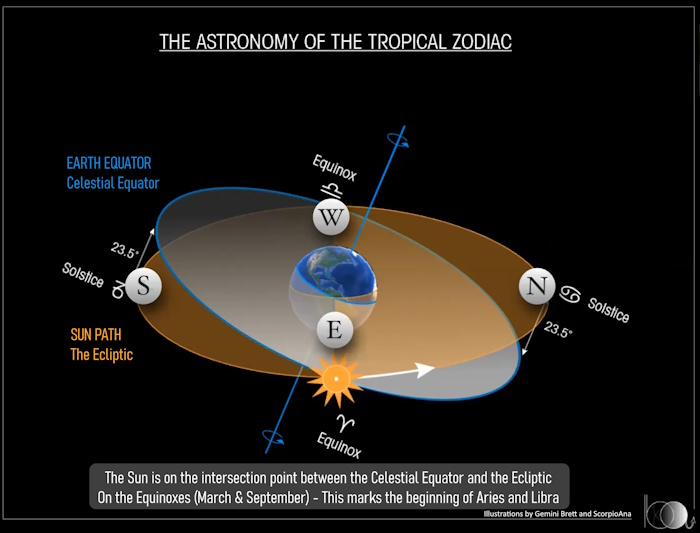
So around this time, they realized they could denote time much easier if they used the zodiac signs to help divide up the sky8. They gave 30 degrees for each of the twelve signs, for a total of 360 degrees. Later influenced by the Egyptians, they went even further by dividing each sign into 10 degrees each, which they called the decans. Introducing decans allowed them to get more granular with their ways of interpreting the world around them9 which we will discuss in the next sections.
Persians Conquer Mesopotamia
In 539 BCE, the Persian king Cyrus the Great captured the city of Babylon and the rest of Mesopotamia fell with it. Now the area was ruled by a foreign king who didn’t care so much about astrology or its culture, so astrologers, who, up until now were centralized around the king’s palace in the capital, spread out into various cities in the region to different temples. It was probably because of this decentralization that natal astrology was developed – this was when astrologers started applying this vast body of knowledge they’d accumulated over 1,500 years to individual birth charts instead of just the king and his empire. Because they could tell time, amazingly, we have birth charts with birth times recorded from that period- an historical first10 and it meant that now- starting around 410 BCE11– astrologers would investigate how a birth chart would affect the future life of a person.
By around 400-300 BCE, Mesopotamian astrologers really began to thin out, and their 2,000 year-old cuneiform culture was having its last gasp12.
In October, 331 BCE, Alexander the Great conquered Babylon and this region was thereafter absorbed into what eventually became the Greek empire.
The Greek elite class would often travel to Mesopotamia or Egypt to study from their scholars, kind of like going to university, so before we move on to Greece, let’s get caught up on what the Egyptians were doing with astrology concurrently during the Mesopotamian empire.
Ancient Egypt
About 1,500 kilometers to the west of Mesopotamia was Egypt, an empire with an astounding 3,000 year-run. No state in human history besides China has outlasted Pharoahnic Egypt that we know of, and no state has outlasted them under the same governmental structure13.
There’s a lot that we don’t know about Egyptian astrology and astronomy because Egyptians wrote on papyrus, organic matter that disintegrates over time except in very specific conditions; whereas Mesopotamians wrote on clay tablets that have lasted decently well throughout the ages. So what we do know largely comes from papyri found in sealed tombs and that which was chiseled into stone in their temples to the gods. Based on evidence that we do have, it does look like Egypt’s astronomical and astrological work is largely derivative of Mesopotamia’s and later, Ptolemaic Greece, so it’s easy at this point in history to dismiss Egypt as specializing more in the religious lore around the heavenly bodies than actually doing astrological calculations and extracting meaning out of their positions in the sky. But honestly, we do not know as much as we otherwise would had they written in a more permanent medium.14
What we do know is that Egypt’s cosmology was very focused on living in harmony with the various characters in the heavenly theater and placating the different gods that ruled the stars, sun, moon, air, and water. Their worship was particularly structured around the cycles of the stars and planets. Consider the star Sirius- in the northern horizon, it pops in an out of visibility throughout the year, but mid-July, it would appear on the eastern horizon far enough away from the sun to be visible and stay visible, signaling to the Egyptians that the Nile was about to flood their farmland with nutrient-rich soil and make their harvests bountiful15. This date was called the heliacal rise of Sirius, and was so important to Egyptian culture and economy that it was considered the beginning of their calendar year.
The other cycle that was foundational to their religion was the daily solar cycle itself. The Sun god Ra’s journey from horizon to zenith to horizon represented the archetypal journey from cradle to midlife to death and then through the dark under world, only to be reborn again in the morning.
Tracking the sun’s movements through its various life stages seemed to be connected to their development of time-measurement, although as Jeremy Naydler says, Egyptian priests didn’t measure time so much as they marked it with special rites and rituals to the gods and goddesses on the hour every hour.
“Far from displaying an abstract succession of numbers, the sun is experienced as going through different qualitative changes, from the apparent frailty of the dawn sun, to the magnificent power of the midday sun, to the mellowness of the evening sun that seems to draw back into itself the light it has distributed through the day. It was by these different qualities of the sun as it traversed the sky that the time of day was known.”16
To help the sun make its underworld journey through the night, priests had to do special rites to the 12 goddesses that ruled each of the 12 hours of the night. Therefore, priests relied on the stars to tell them what time it was at night to perform the appropriate ritual 17.
… The most important stage of this journey was the confrontation of Ra with the demonic serpent Apophis, who embodied the forces of darkness. ” – Naydler pg. 63-65
Instead of using the planets’ journey through the zodiac to track time like the Mesopotamians, Egyptian priests used the rotation of the stars18.
Egyptians divided clusters of fixed stars into groups of 36 that they called “decans”. Each decan was divided into 10 days- in fact the decan was their version of a week. Each decan represented a divine principle, and Egyptians found that it would have certain qualities that would be expressed most prominently when it was either ascending over the horizon (at what would come to be known as the Ascendant) or when it was at the highest point in the sky (at what would come to be known at the Medium Coeli). The female sky god Nut was responsible for rotating the sky- the decans along with it- so that each decan had its turn rotating through the highest point in the sky. Historians believe this was the beginning of the concept we know today of angularity, the idea that planets are strongest when they’re at the “angles” of a chart: near the Ascendant (AC), the Medium Coeli (MC), the DC (Descendant) and the Imum Coeli (IC). The star Sirius that brought fecundity to the Nile was so important that she was positioned at the beginning of the decan wheel, in other words, she was the ascendant of the decans19.
Sirius was so important to the calendrical system that by the Ptolemaic period, she was conflated with the goddess Isis, the sister/wife of King Osiris in the Osiris myth.20
… “Above all, the calendrical system aimed to attune Egypt to the divine being who manifested herself in the star Sirius, and who was none other than Isis, the all-sustaining mother of the universe.
Naydler quotes Isis as saying,
I am the one who rises in the Dog-star [Sirius].
I am the one called goddess by women.
… I separated the earth from the Heaven.
I showed the paths of the stars.
I regulated the course of the sun and the moon.21
Despite having trade relationships back and forth, it appears that Egypt and Mesopotamia only really started sharing astrological or astronomical information around 500 BCE22. Egyptians translated a Mesopotamian omen text into their language around 500 BCE, and around 200 BCE, Egyptians started incorporating the zodiac symbol into their temple designs. Around this time as well, they incorporated their decans into the zodiac constellations as ten-degree increments of each sign, so by the first century BCE, masterful depictions like the Zodiac of Dendera were carved into the Hathor temple at Dendera23.
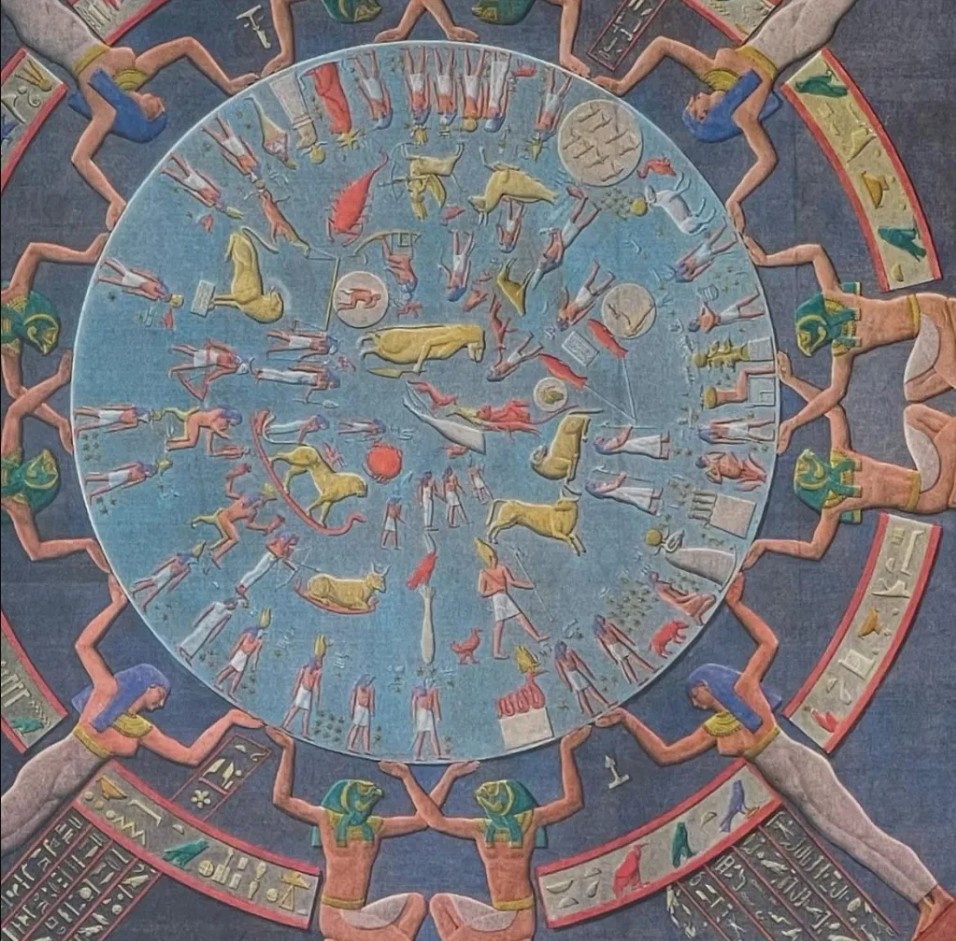
We can also see in the above Dendera carving that somehow between the Egyptians and Mesopotamians, it had already been decided in which zodiac sign each of the planets was exalted, as here we can see the visible planets are grouped next to the signs in which they’re exalted.24
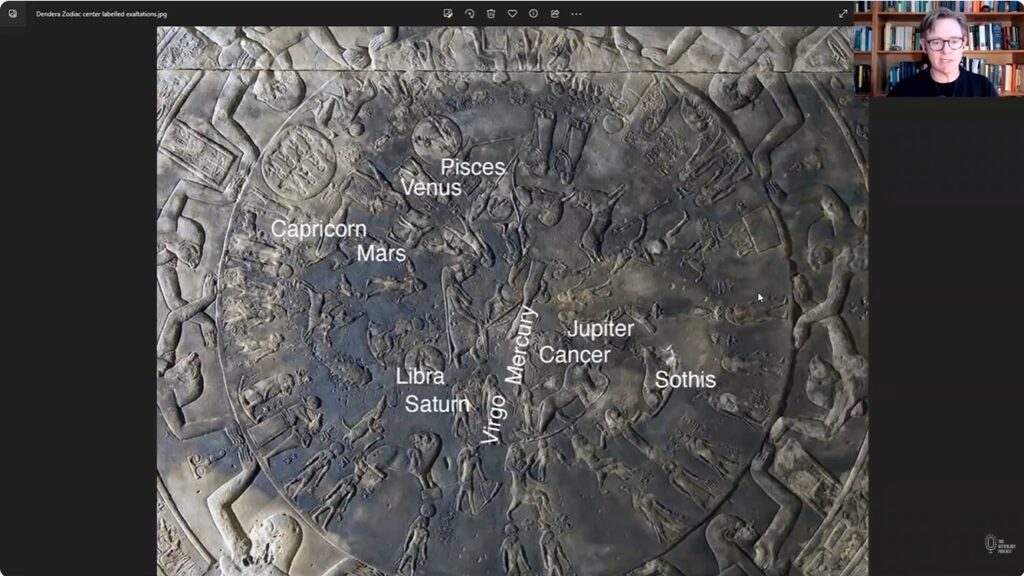
That is not to say that the 12 houses were ascribed their respective meanings or which planet ruled which house- those decisions would come later in the Hellenistic period26.
Pythagoras and Plato
“Platonic-Pythagorean conviction that the Creator of the universe expressed the divine intelligence through mathematical forms and geometric harmonies of an eternal, transcendant nature, and
Before we meet up with Alexander the Great’s conquering of Egypt, we need to spend some time with Greek philosophers Pythagoras (570 BCE to 495 BCE) and Plato (428/427 to 348/347 BCE). While, as far as we know, neither of them made specific contributions to what we understand as Hellenistic astrology techniques, their respective philosophies were important to the development of meaning behind astrology and astronomy
Pythagoras was reputed to have a variety of different teachers- no one knows for sure. Possible teachers range from actual Pharoahs to Egyptian priests to Persias, Phoenicians, Chaldeans Jews, Indians, Celts and Ibierians27. Either way, he came to teach a form of mysticism that found its way into astrological beliefs later on. He believed in the sacred harmony of mathematics, geometry music, rhythm, and the inherent meaning in numbers. So his belief in the divine forms. Thanks to the Mesopotamians, we have the decimal system. So the numbers one to ten are archetypes for all the infinite numbers that come after the first ten. One is the most important because the 8 digits that come after it describe the One, and they are the Many. The One is God, and the
Geometry is also the bridge between the One and the Many. When you draw one of its basic figures- a circle, say, or a triangle or regular polygon- you do not copy someone else’s drawing; your model is the abstract ideal of a circle or triangle. It is the perfect form, the unchanging, unmanifest One. Below it are the Many- the expressions of that figure in design, art, and architecture. In nature also the One circle gives rise to the Many, in the shapes and orbits of the planets, in the roundness of berries, nests, eyeballs, and the cycles of time. On every scale, every natural pattern of growth or movement conforms inevitably to one or more of the simple geometric types.28
went underground after he died. His reverence for geometry was kept alive through the writings of Plato and the Neo-Platonists.
Living in the world without insight into the hidden laws of nature is like not knowing the language of the country in which one was born.29
Plato later developed the idea of the One and the Many. This is an abstracting away from a central idea or quality of the divine. The One is God or the nine qualities of God, and the Many are all the various manifestations of the archetypes denoted by 1 to 9.
Plato, especially in Timaeus, showed himself a Pythagorean, as were the Neoplatonists of Alexandria in the third, fourth, and fifth centuries AD. The early Christian church seems to have evinced no interest, but Boethius, with Rome crumbling about him in the sixth century, gathered together what remained of Pythagorean doctrine and wrote it down before being bludgeoned to death by Theodoric. Though apparently not a Christian, Boethius enjoyed great esteem within the otherwise intolerant church, and Pythagoreanism was never entirely submerged.
Enlightened elements within Islam, probably inheriting the teaching of the later Neoplatonists, kept the flame alive, and it seems possible that it may have survived, more or less underground, in Gnostic, Hermetic and alchemical societies. In any case, it survived (or conceivably, was reformulated afresh through direct revelation), for it surfaced in full flower in the Gothic cathedrals30.
: the idea of planets as archetypes that manifested outcomes in various ways in our lives. Up until now, the planets were not causal agents, but it was around this time, when at least Mesopotamian astrologers were doing birth charts for individuals rather than the king, that the debate about fate versus freewill formed:
“In 410 BCE, there’s this new development in Mesopotamia where we suddenly have the introduction of the concept of birth charts. And this took the idea of astrology that there was a correlation between celestial movements and earthly events, and it personalized it by saying that the alignment of the cosmos on the day that a person- or the moment that a person was born- has something specific to say about their life and about their future. And so that principle has a lot of implications in it about individuals and their lives and how they’re set up and what their relation is to the cosmos as well as that there may be something pre-determined to some extent about the future.”31 (Brennan, Astrology and Ancient Philosophy)
Greek- Hellenistic Period (323-30 BCE)
Alexander the Great conquers Mesopotamia and Egypt in 4th Century, like 323 or 331
Suddenly much of near East is under control of Greek-speaking rulers. Greek becomes a common language. You see Mesopotamian astrologers talking with Greeks, doing consultations, travelling to and immigration to Greece and starting to teach astrology. Direct borrowing of concepts- Ptolemy is borrowing from Babylonia- 2:39:00. Length of synodic month- Babylonians calculated this with incredible precision. Suddenly Mesopotamian astrologers are now in the same empire as people in Egypt, as people in the Aegean world, as people in Anatolia and Lydia. Wide degree of cross-pollination. Other forms of theoretical astrology and data. one of the Mesopotamian horoscopes had a greek name.
Babylonia is in ruins by 1st century CE. Memory of how to read cuneiform dies out. Cities are mostly abandoned. Texts are buried in the ground.
After the 1st century BCE, the greater part of Mesopotamian astrology gets passed off to the Greeks, to the Egyptians and Romans, and they start practicing it in their own language and elaborating on it, and astronomical models that they inherited from the Mesopotamians. But knowledge of how how read cuneiform was lost.
Common Era
Dorotheus of Sidon was a very influencial Hellenistic astrologer who claims to have written a compendium of Petosiris and Nechepso. His work on horoscopic astrology, Pentateuch, or Carmen Astrologicum, was foundational and it brought together a lot of Mesopotamian, Greek, and Egyptian astrological techniques. His works were later brought to Arabia where they were translated into Persian then Arabic in the 8th century. While Dorotheus was highly influential throughout the Hellenistic period, his works were eventually lost and the Medieval world came to depend moreso on Ptolemy, who was perhaps less of an authority on Hellenistic techniques than Dorotheus was.
Ptolemy (c. 100 – 160s/170s AD32)- Alexandria, Egypt. Ptolemy laid the foundational models for astronomy, famously developing the geocentric system, a mathematical model of the universe placing Earth at the centre, which dominated scientific thought for over 1,000 years.
3rd century CE- Neoplatonism- Greco-Roman world. Plotinus (c. 205-270 CE) and his teacher Ammonius Saccas until closing of Platonic Academy in 529 CE. All reality is an emanation from a singular, transcendant supreme reality known as “the One”.
4the century- Firmicus
1490s to 1527- Renaissance- Leonardo, Michaelangelo, Raphael
Thema Mundi
Having cancer rising at the birth of the world.
2nd century BCE
Astrologers getting known as Chaldeans. Diffusing throughout Greece, southern Europe, Egypt. Getting kicked out of Rome- known as a group of diviners. Chaldeans or astrologers in general? Cicero argues against the practice in De Divinatione, so it might be a campaign against astrologers in general.
Scientific Revolution (influential on the Reformation, but separate)
1503-1566- Nostradamus- astrologer for Catherin de’ Medici, published Les Prophties in 1555.
1508-1514- Copernicus- heliocentric theory- De Revolutionibus– the earth revolves around the Sun. Idea condemned by Luther, Calvin, etc. “The nature of the Copernican revolution was so fundamental that what had to be rethought was not only all the conventional scientific theories but the entire established hierarchy of humanity’s place in the universal scheme of things: its relation to th resto f nature and to the cosmos, its relation to the divine, the basis for its morality, its capacity for certain knowledge, its historical self-understanding…. The entire world needed to be revisioned. In the end, the implicationof the great shift- cosmological, religious, moral, epistemological, psychological, existential- were so far-reaching that it would take centuries to work them out, even to become conscious of them.”- Tarnas
1527-1608- John Dee- astrologer to Queen Elizabeth I
1564- Galileo
1605-1619- Kepler- his writing of the laws explained that phenomenon that pushed science to a mathemtaically modelled universe. We could’ve simply pursued sicence like the babylonians did like observe, record, observe record. But Kepler’s laws of gravitational motion tried to create a mathematical explanation for the universe that didn’t just leave us observing, but gave us a tool for predicting, which really changes the course of science.
1543-1687- Isaac Newton’s Laws of motion
1685-1815- Enlightenment
Tang Dynasty- they don’t have discovery of heliocentrism because they always understood. We were trapped in Aristoleanism. Stuff everything you can into Aristotleanism because that’s the only thing the church will allow.
Freud
1920’s – Mme. Blavatsky, Alan Leo, New Age
Carl Jung- synchronicities- alchemy, solar journey
“Central to Jung’s understanding of such phenomena was his observation that the underlying meaning or formal factor that linked the synchronistic inner and outer events- the formal cause, in Aristotelian terms- was archetypal in nature. Building on insights from Freud, and drawing from the classical Platonic philosophical vocabulary and from esoteric traditions, Jung had long regarded and defined archetypes as the fundamental governing principles of the human psyche.
Invention of Sun Sign astrology
Modern Astrology
Recovering of Hellenistic astrology
- Brennan, Chris and Dr. M. Willis Monroe, Mesopotamian Astrology, The Astrology Podcast at 20:00 ↩︎
- Brennan, Chris and Dr. M. Willis Monroe, Mesopotamian Astrology, The Astrology Podcast at 26:30 ↩︎
- For more eclipses around the British royal family, see The Astrology Podcast episode Eclipses that Aligned with Important Events in History, by Chris Brennan and Nick Dagan-Best, Oct 20, 2023. ↩︎
- Annus, Amar, On the Beginnings and Continuities of Omen Sciences in the Ancient World, from the book Divination and Interpretation of Signs in the Ancient World, University of Chicago, 2010. ↩︎
- Wikipedia, MUL.APIN, accessed on July 15, 2026 ↩︎
- Seife, Charles, Zero: The Biography of a Dangerous Idea, Penguin Books, New York, 2000. ↩︎
- Brennan, Chris, Hellenistic Astrology: the Study of Fate and Fortune, Amor Fati Publications, 2017, pg. 3 ↩︎
- Monroe, M. Willis, in podcast Mesopotamian Astrology, The Astrology Podcast, at 1:41:00 (verify) ↩︎
- Monroe, M. Willis, in podcast Mesopotamian Astrology, The Astrology Podcast, at 1:41:00. ↩︎
- Monroe, M. Willis, in podcast Mesopotamian Astrology, The Astrology Podcast, at 2:00:00 (verify) ↩︎
- Brennan, Chris in podcast Astrology and Ancient Philosophy, The Astrology Podcast at 9:20 ↩︎
- Monroe, M. Willis, in podcast Mesopotamian Astrology, The Astrology Podcast, at 2:12:00 ↩︎
- Tollen, David, The Unbelievable Duration of Egyptian Civilization, Pints of History, August 8, 2011. Accessed on July 19, 2026. ↩︎
- Quack, Joachim, Egypt as an astronomical-astrological centre between Mesopotamia, Greece, and India, Heidelberg University, 2018. Accessed on July 19, 2026. ↩︎
- Hunt, Dr. Jeffrey L. 2026: Sirius Heliacal Rising – Dates, Egyptian Calendars, and First Morning Appearance, www.whenthecurveslineup.com, Accessed on July 20, 2026. ↩︎
- Naydler, Jeremy, Temple of the Cosmos: The Ancient Egyptian Experience of the Sacred, Inner Traditions, Rochester, Vermont, 1996, pg. 63. ↩︎
- Naydler, Jeremy, Temple of the Cosmos: The Ancient Egyptian Experience of the Sacred, Inner Traditions, Rochester, Vermont, 1996, pg. 62. ↩︎
- Brennan, Chris, Hellenistic Astrology: the Study of Fate and Fortune, Amor Fati Publications, 2017, pg. 7 ↩︎
- Dr. David ___, in podcast The Astrology of Egypt, The Astrology Podcast at ___ (verify) ↩︎
- Wikipedia, Sopdet, accessed on July 31, 2026. ↩︎
- From the “Aretalogy of Kyme” in Louis V. Zabkar, Hymns to Isis in her Temple at Philae (Hanover, N.H., and London: University Pres of New England, 1988), pg. 140. ↩︎
- Wikipedia, Egypt-Mesopotamia relations, accessed on July 19, 2026 ↩︎
- Brennan, Chris, Hellenistic Astrology: the Study of Fate and Fortune, Amor Fati Publications, 2017, pgs. 8-9 ↩︎
- Brennan, Chris and Dr. Ian Moyer, Ancient Egyptian Astrology, The Astrology Podcast at 2:35:50 ↩︎
- Brennan, Chris and Dr. Ian Moyer, Ancient Egyptian Astrology, The Astrology Podcast at 2:35:50 ↩︎
- Brennan, Chris, Hellenistic Astrology: the Study of Fate and Fortune, Amor Fati Publications, 2017, pg. 31 ↩︎
- Wikpedia, Pythagoras, accessed on July 31, 2026 ↩︎
- Schneider, Michael S., A Beginner’s Guide to Constructing the Universe: The Mathematical Archetypes of Nature, Art, and Science, HarperCollins, 1994, pg. xv-xvi ↩︎
- Schneider, Michael S., A Beginner’s Guide to Constructing the Universe: The Mathematical Archetypes of Nature, Art, and Science, HarperCollins, 1994, pg. xxi ↩︎
- West, John Anthony, Serpent in the Sky: The High Wisdom of Ancient Egypt, Theosophical Publishing House, Wheaton, IL, 1993, pgs. 19-20. ↩︎
- Brennan, Chris, Astrology and Ancient Philosophy, The Astrology Podcast, at 9:15 ↩︎
- Wikpedia, Claudius Ptolemy, accessed August 4, 2026 ↩︎